
What conversations is your team willing to have with you?
It’s a question most CEOs don’t ask often enough.
We spend a lot of time thinking about strategy, execution, talent, and results. All of that matters. But underneath it is something more basic:
Can your leadership team talk honestly about what is really happening?
Not after the meeting.
Not privately with the person they trust most.
Not once the problem has become impossible to ignore.
In the room.
While something can still be done about it.
That may be one of the most useful measures of a leadership team I know. Jim Collins refers to this as “Brutal Honesty”, not only the hard data, but face to face hard discussions too.
Every Organization Has Difficult Conversations
Every organization has difficult conversations.
Some have them in the room.
Others have them in the parking lot.
The conversations themselves aren’t optional.
People already know what isn’t working. They know where accountability is slipping. They know which decisions keep getting avoided. They know when tension exists between two leaders, when an initiative has lost momentum, or when the team is agreeing publicly with something they question privately.
The only real variable is where those conversations happen.
Do they happen in the room, where the people involved can understand the issue and do something about it?
Or do they happen afterward — in the hallway, the parking lot, or the group chat?
That distinction matters.
Because a leadership team can look aligned without actually being aligned.
Everyone can leave the meeting agreeing on paper while carrying very different conversations out the door.
Polite Is Not the Same as Healthy
At a recent Gravitas Growth Intensive, my friend David Irvine offered a distinction that stuck with me:
“The opposite of engagement is not disengagement.
The opposite of engagement is polite.”
Think about that.
A leadership meeting can look perfectly healthy from the outside.People are professional. Respectful. Nobody raises their voice. Everyone nods at the appropriate moments.
And very little of substance gets said.
Politeness can look like alignment when it’s really avoidance.
That doesn’t mean the answer is bluntness dressed up as honesty.
There’s an important distinction between being honest and simply passing judgment.
Someone might respond to an idea with, “That’s a bad idea,” and believe they’re being honest.
Maybe they’re right.
But the judgment alone doesn’t create much room for a productive conversation.
A stronger response might be:
“I’m concerned about that direction, and here’s why.”
Now you’ve moved from judgment to something the team can explore. You can understand the concern, test the assumptions behind it, and decide what to do with it.
Strong leadership teams learn to tell the truth without turning every disagreement into a verdict. They hold two things at once:
Honesty and respect.
Not honesty instead of respect.
And not respect used as an excuse to avoid honesty.
Sometimes It Isn’t a Trust Problem
We often assume that when people aren’t speaking honestly, the organization has a trust problem.
Sometimes it does. In his book The Five Dysfunctions of a Team Pat Lencioi dissects the Trust issue and how to build Trust and then ascend toward results using the 5D Pyramid
Trust → Conflict → Commitment → Accountability → Results
But sometimes people simply don’t know how to have the conversation.
It may not be a trust issue.
It may be a skill issue.
That distinction matters because difficult conversations are not something most people naturally know how to navigate well.
How do you disagree without attacking? How do you challenge a peer without making the conversation personal?How do you tell the CEO something they may not want to hear? How do you stay curious when someone challenges an idea you believe strongly in?
Those are leadership skills.
I’ve seen teams avoid an issue for months because nobody knew how to enter the conversation without creating unnecessary conflict. Then somebody finally finds the right question, the right language, or enough courage to put the issue on the table. Suddenly the conversation everyone was avoiding becomes the conversation that moves the team forward.
The goal isn’t conflict for the sake of conflict. It’s building a leadership team capable of staying in an honest conversation long enough to learn something from it.
Silence Is Data
One of the places I pay attention is silence.
Someone who normally contributes goes quiet. Someone leans back (body language makes a statement). Someone reaches for the phone. You ask a direct question and suddenly nobody has anything to say.
It’s easy to move on. But if we want to be effective leaders, we cannot. We must pause and go deeper.
When I notice someone physically in the room but clearly somewhere else, I may stop and ask:
“What’s going on inside of you right now?”
Then I stop talking.
That part matters.
Silence can make leaders uncomfortable. We feel responsible for keeping the meeting moving, filling the space, finding the answer. But a good question sometimes needs room to work. The first answer is not always the useful one. Sometimes you can actually watch someone processing what they think, what they feel, and whether they are willing to say it.
Silence isn’t always a problem to solve. Sometimes it’s the doorway into the conversation you actually need to have. An effective coach can interpret silence just as well as they can understand the words being spoken by a leader.
Leaders Shape What Happens Next
Getting the truth into the room is only part of the work. What happens after someone says it matters just as much.
Someone raises a concern and the conversation immediately becomes defensive. People notice.
Someone challenges an assumption and the team stays with the disagreement long enough to understand it. People notice.
Someone names the issue everyone has been carefully stepping around.
What happens next matters.
Teams develop patterns, just like families. Some functional, many dysfunctional. They learn which subjects can be discussed. Which disagreements can be explored. Which tensions get resolved. And which ones everyone quietly learns to leave alone.
Over time, those patterns become the real rules of the room.
That’s why honesty and accountability have to work together. Honesty without accountability becomes conversation without consequence. Accountability without honesty means people may execute against a version of reality they don’t actually believe.
A strong leadership team has to be capable of doing something more difficult.
Surface the issue.
Stay in the conversation.
Understand what is actually happening.
Decide what needs to happen next.
Then hold one another accountable for doing it.
That is when an uncomfortable conversation becomes a productive one.
The Method: A Practice Tool for CEOs
The High Performance Triangle
At the beginning of a relationship with a new client, I always teach them the High Performance Triangle of leadership teams — a practical tool derived from Jim Collins' Good to Great research, Pat Lencioni's work with trusting teams, and Liz Wiseman's foundational Multipliers principles. It is simple, effective, and elegant.
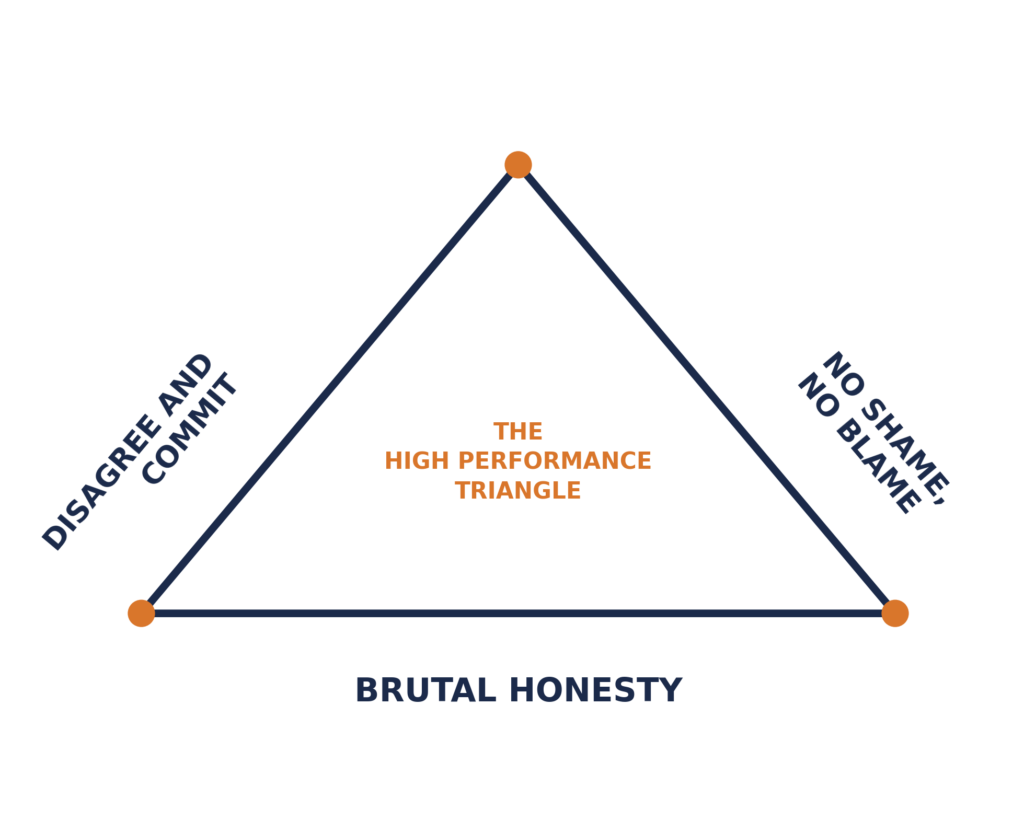
STEP 1 — BASE: “Brutal Honesty.” Ask: “What does this mean to you?” Call on a couple of leaders to comment.
STEP 2 — RIGHT DIAGONAL: “No Shame, No Blame.” Ask again: “What does this mean to you?” Call on a couple more leaders.
STEP 3 — LEFT DIAGONAL: “Disagree and Commit.” Ask once more: “What does this mean to you?” Call on another set of leaders.
Once the team has learned and discussed the triangle, start every session by drawing and reviewing it. By year's end, everyone in the room will have led this exercise live with their own leadership team and working teams.
In two decades of coaching, this simple tool has created an extraordinary amount of freedom, safety, and trust as leaders put it into play with one another
The Measure
You can measure a lot in business.
Revenue.
Profit.
Retention.
Execution against the plan.
All useful.
There's another measure worth paying attention to:
What can your leadership team actually talk about?
What gets said in the room — and what gets saved for the parking lot? What issues does everyone know about but no one names? When disagreement surfaces, does your team stay with it long enough to understand it — or move quickly back to polite?
And perhaps the most important question:
What conversation does your leadership team need to have that it still isn't having?