
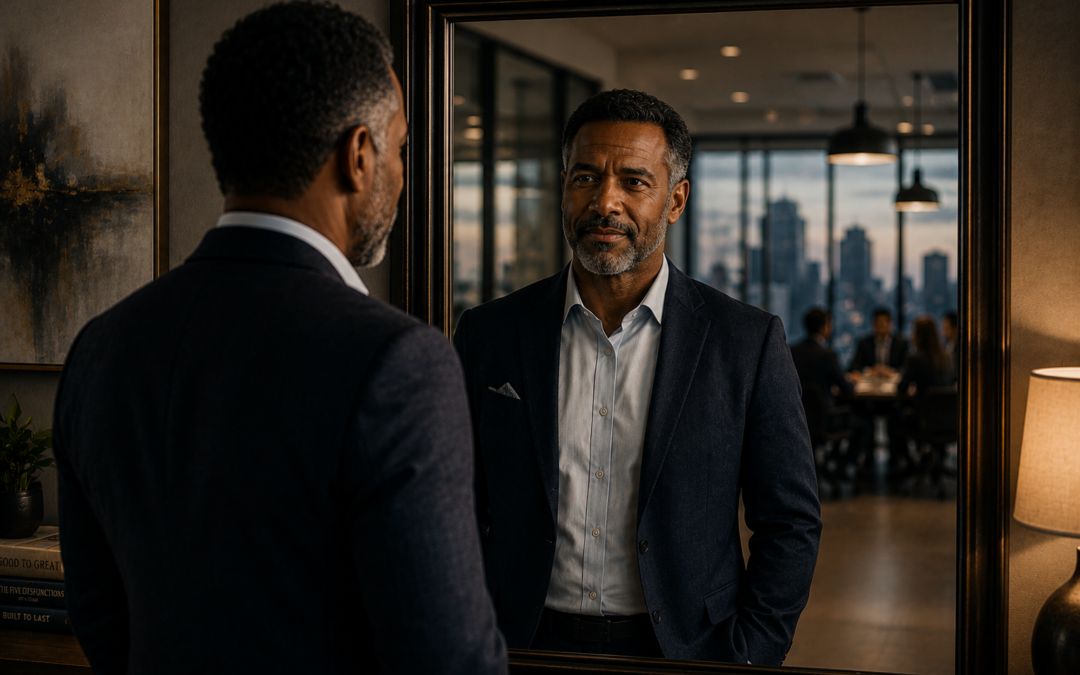
Part I: The Company You Build Will Rarely Outgrow the Leader You Become
By Keith Cupp
There was a season in my career when I believed that if I could simply learn one more framework, one more strategy, or one more leadership tool, I could help every CEO overcome the challenges standing between them and their next stage of growth.
After more than twenty years coaching CEOs and leadership teams around the world, I still value great frameworks. In fact, much of my life's work has been devoted to creating practical frameworks that help leaders build exceptional businesses.
But over time, experience taught me something no framework could.
The greatest breakthroughs rarely happen because a leader discovers a better strategy.
They happen because the leader becomes a different person.
I've watched remarkable CEOs transform struggling companies without changing their markets.
I've also watched brilliant executives with flawless strategies plateau because, despite all their intelligence, they had quietly stopped growing themselves.
I once worked with a young CEO — brilliant, coachable, sincerely trying — who could not see his own blind spot. His COO saw it clearly. She just couldn't bring herself to say it out loud.
When we finally got the two of them in a room and named what was actually happening, something shifted. He owned what he saw. She found the courage to keep naming it going forward.
They went on to build something far bigger than the company that almost stalled in that room.
That realization changed how I coach.
More importantly, it changed what I now believe leadership requires.
Success Eventually Introduces a New Challenge
One of leadership's greatest paradoxes is that the very strengths that helped build your company can eventually become the very barriers preventing it from reaching its next level.
The decisiveness that helped you launch the business can become control.
Your confidence can become certainty.
Your passion can become impatience.
Your expertise can make it difficult to remain curious.
I've seen this pattern hundreds of times.
Not because leaders lack character.
Because success quietly convinces us we've arrived.
Over time, growth has a way of exposing what success conceals.
Every new level of responsibility demands a new level of leadership.
And every new level of leadership requires deeper inner work.
The Leadership Ceiling Is Internal Before It Is External
When companies stop growing, leaders often point outward—to the market, to competition, to economic conditions, to a shortage of talent.
Sometimes those are genuine constraints.
But more often than we care to admit, the greatest limitation isn't external.
It's internal.
The questions become harder.
Can I trust others with decisions I once made myself?
Can I remain teachable after decades of success?
Can I hold strong convictions without becoming defensive?
Can I create space for others to flourish instead of proving my own value?
These aren't strategic questions.
They're leadership questions.
And leadership is always personal.
I've come to believe that every organization eventually reflects the emotional maturity of its leadership.
Culture mirrors character.
Trust mirrors integrity.
Accountability mirrors humility.
Alignment begins long before it appears on an organizational chart. It begins within the leader. That conviction has shaped much of our work at Gravitas, where organizational alignment is viewed as an extension of personal alignment rather than a substitute for it.
Leadership Is an Inside-Out Journey
Years ago, my friend David Irvine shared an observation I've never forgotten: mastery begins not with technique, but with authenticity.
He was talking about coaching.
I've come to believe it's just as true of leadership.
People experience your presence long before they experience your methods.
That resonates deeply with what I've witnessed over two decades.
People don't follow leaders because they possess perfect answers.
They follow leaders because they trust who that leader is.
The best CEOs I've worked with share an interesting characteristic.
They remain curious.
They invite challenge.
They ask for feedback they may not enjoy hearing.
They are willing to confront uncomfortable truths before circumstances force those truths upon them.
Ironically, the higher they rise, the more committed they become to learning.
The Work That Never Ends
There is no graduation ceremony for leadership.
No finish line where self-awareness is complete.
Leadership isn't a destination.
It's a continual process of becoming.
That process often requires slowing down rather than speeding up—listening more than speaking, reflecting before reacting, trading certainty for curiosity, choosing courage over comfort.
You won't find these on a scorecard. Yet they quietly shape every conversation, every decision, every relationship, and ultimately every result.
The healthiest organizations I've encountered were almost always led by people who had committed themselves to this kind of inner work.
Not because they were perfect.
Because they remained willing to grow.
An Invitation
Perhaps this month, instead of asking,
"How do I grow my company?"
Ask a different question.
Who must I become for my company to grow beyond its current limits?
The answer may not come through another business book, another planning session, or another strategic initiative.
It may emerge in moments of honest reflection.
In conversations where you choose to listen instead of defend.
In decisions that require greater courage than competence.
In the quiet work no one else sees.
Because while companies certainly grow through strategy, execution, and accountability, they rarely outgrow the leader who is guiding them.
Sustainable execution and accountability are strengthened when leaders first cultivate those qualities within themselves.
And perhaps that is leadership's greatest invitation:
To become someone capable of leading the future your business is ready to build.
This is where the conversation begins.
In Part II, we'll turn to the coach—and the inner work required to guide others through their own growth.