
Consider this:
Your CEO clients are experimenting with AI.
Some are using it to improve productivity.
Some are using it to accelerate processes.
Some are hoping it will create strategic advantage.
And many are discovering something they did not expect.
AI is not simply helping them move faster.
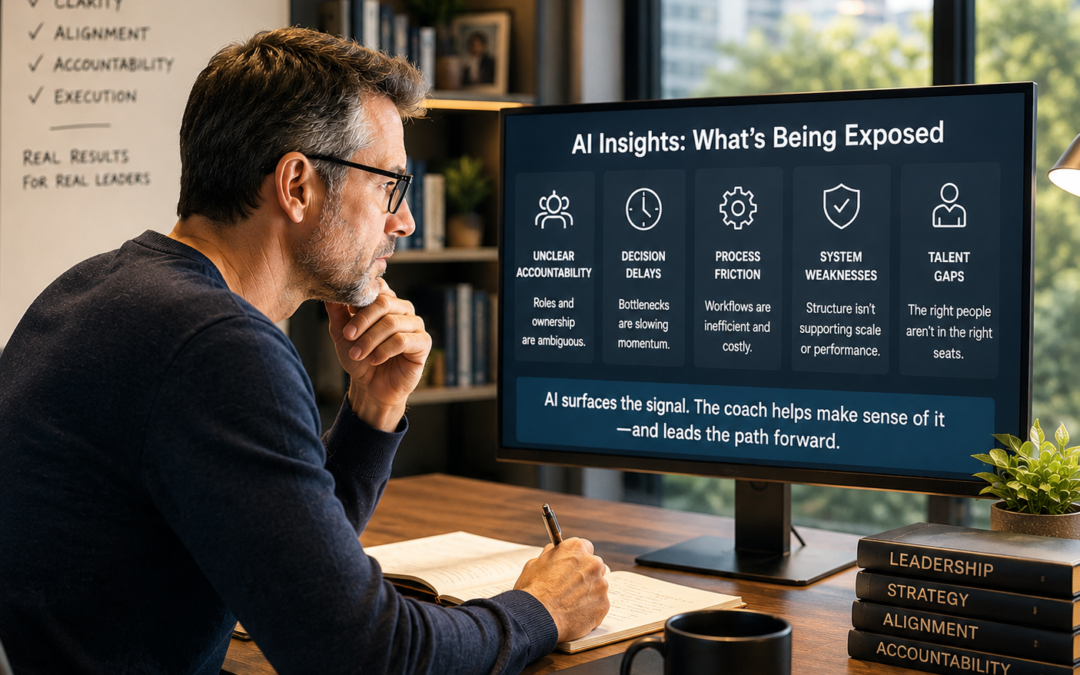
It is revealing where their businesses are unclear, misaligned, or structurally fragile.
The friction.
The ambiguity.
The hidden cost of systems that appear to be working.
Which raises an important question for us as coaches:
Are we prepared to help them interpret what AI is exposing?
This is a significant value driver for your client, and they may not be looking for exposures.
AI Is Not Replacing the Coach
There is a lot of noise right now about AI and coaching.
Much of it misses the point.
AI may accelerate research.
It may improve preparation.
It may help us summarize, synthesize, and pressure-test ideas.
But it does not replace judgment.
It does not replace presence.
It does not replace the ability to sit with a CEO and help them see what they are avoiding, tolerating, or unintentionally reinforcing.
Used well, AI becomes a powerful thinking partner.
But the coach is still responsible for the interpretation of this thinking.
What Happens When the Business Speeds Up
One of our coaches has been working with a CEO who approached AI the way many leaders are right now: curious, cautious, and optimistic.
At first, the goal was straightforward.
Improve personal productivity.
Create process efficiencies.
Possibly discover new sources of strategic differentiation.
But after a year of applying AI personally and across key business processes, something shifted.
The CEO began to see the business differently.
AI was not just helping him build new things.
It was exposing what was already fragile.
Unclear handoffs.
Slow decisions.
Inefficient processes.
Assumptions that had gone unchallenged for too long.
In other words, the business did not simply get faster.
It became more visible.
And visibility changes the coaching conversation.
The Coach’s Role Is Becoming More Important
When a CEO accelerates workflows, compresses timelines, and pushes decisions harder and faster, friction shows up sooner.
That is not failure.
It is signal.
The coach’s role is not to make the signal more comfortable.
It is to help the CEO understand what the signal means.
Where is value leaking?
Where are decisions slowing down?
Where are systems failing talent?
Where is accountability structurally unsupported?
Where is talent failing execution?
Those are not AI questions.
That is where the coaching actually begins.
The Deeper Coaching Question
For years, many coaches created value by bringing insight into the room.
Pattern recognition.
Frameworks.
Experience.
Perspective.
Those still matter.
But now, patterns are surfacing faster.
The opportunity is not simply to bring insight.
It is to help leaders make sense of what is being revealed.
To separate symptoms from systems.
Activity from progress.
Speed from wisdom.
Data from meaning.
That is a higher standard.
And it is a more valuable role.
What AI May Expose in Us
But we should be honest.
AI is not only exposing the client’s business.
It may also expose the coach’s practice.
Where are we relying on experience without enough structure?
Where are we diagnosing symptoms instead of systems?
Where are we preparing slower than we need to?
Where are we tolerating unclear follow-through or inconsistent client value?
Those are not comfortable questions.
But they are useful ones.
Because the same principle applies to us:
When things speed up, what is underneath becomes visible.
And if we are asking CEOs to look honestly at what AI is exposing in their businesses, we should be willing to do the same in our own.
The Coaches Who Will Create the Most Value
The coaches who create the most value in this next season will not be the ones using the most AI tools.
They will be the ones who combine Artificial Intelligence with Human Intelligence in a disciplined, practical, deeply human way.
They will use AI to prepare more rigorously.
To identify patterns faster.
To sharpen better questions.
To help CEOs see the business as a system.
But they will not confuse speed with wisdom.
The competitive edge is not AI itself.
It is the coach’s ability to help a CEO respond to what AI reveals—with clarity, accountability, and disciplined action.
Reflection
Consider these questions:
Where could AI help you see your client’s business more clearly?
Where could it help you prepare with greater depth?
Where could it expose friction in your own coaching practice?
And most importantly:
Are you using AI as a tool for efficiency—or as a thinking partner for mastery?
AI is not the coach.
It is simply revealing the work.
The question is whether we are willing to see it clearly—
and help our clients act on it with discipline.